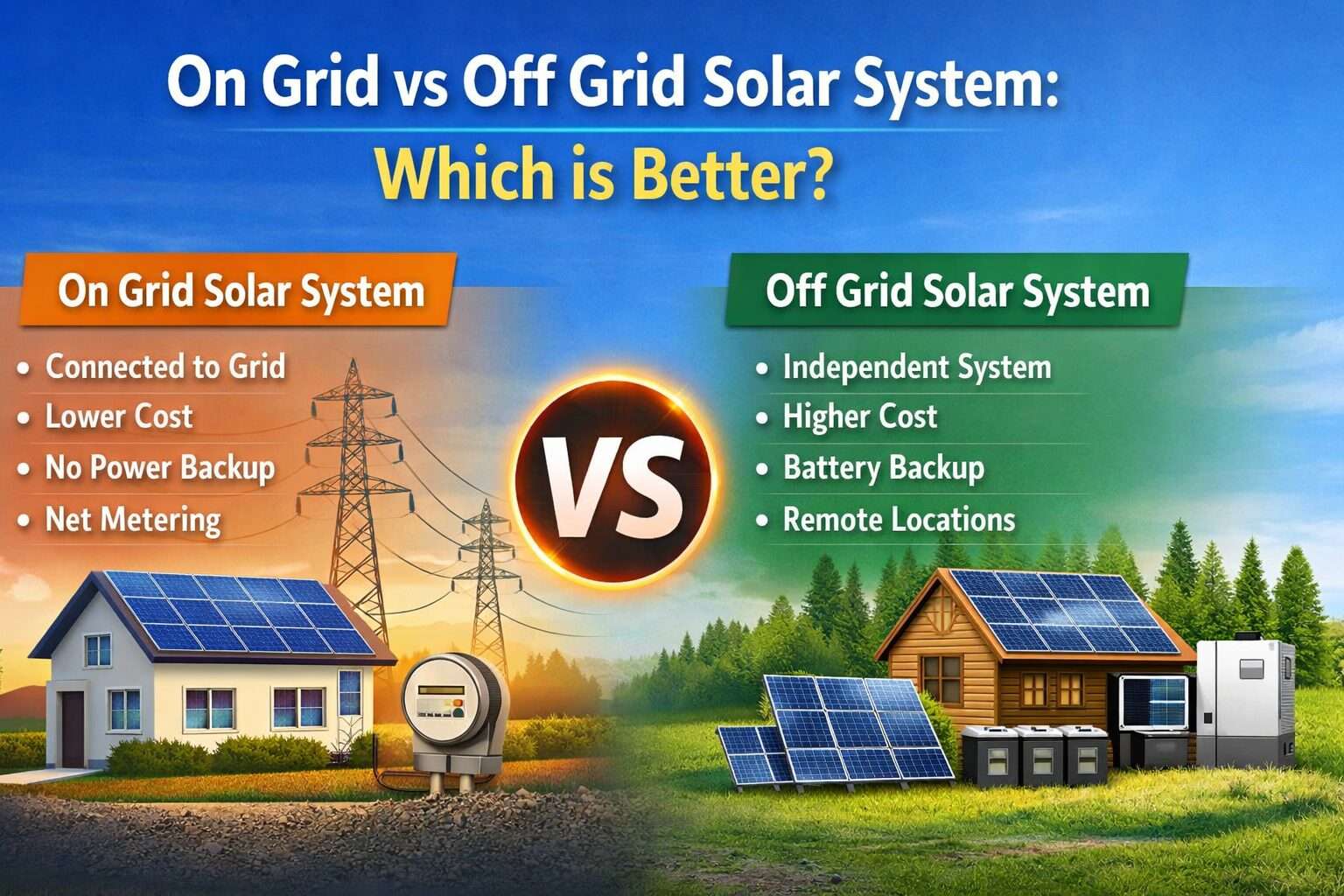
On Grid vs Off Grid Solar System: Which is Better for Your Home?
Table of Contents
Solar energy is rapidly becoming the preferred choice for homeowners and businesses looking to reduce electricity bills and move toward clean energy. However, when people start researching solar systems, one common question comes up:
On Grid vs Off Grid Solar System — which one is better?
Both systems generate electricity using solar panels, but the way they work and their purpose are quite different. Choosing the right system depends on factors like electricity availability, budget, backup needs, and long-term savings.
In this guide, we will explain the difference between On Grid and Off Grid Solar Systems, their advantages, limitations, and how to decide which one is the right choice for your home or business.
What Is an On Grid Solar System?
An On Grid Solar System, also known as a Grid-Tied Solar System, is directly connected to the local electricity grid.
This means your solar panels generate electricity during the day and power your home. If your solar system produces more electricity than you need, the excess energy is sent back to the grid through net metering.
Similarly, when your solar panels are not producing enough electricity (for example at night), your home automatically uses power from the grid.
Key Components of an On Grid Solar System
Solar Panels
Grid-Tied Solar Inverter
Net Meter
Mounting Structure
Electrical Wiring
How It Works
Solar panels capture sunlight and generate DC electricity.
The inverter converts DC electricity into AC electricity for home use.
Extra electricity is exported to the grid.
When needed, electricity is imported from the grid.
Benefits of an On Grid Solar System
1. Lower Installation Cost
On grid systems are usually more affordable because they do not require batteries, which are the most expensive part of a solar system.
2. Maximum Savings with Net Metering
If your system generates extra power, it is exported to the grid and you receive credits on your electricity bill.
3. High Efficiency
Without batteries, there is less energy loss, making the system more efficient.
4. Easy Maintenance
Since there are fewer components involved, maintenance is relatively simple.
5. Government Subsidy Availability
Many government solar subsidy programs are mainly available for on grid solar systems.
Limitations of an On Grid Solar System
Even though on grid systems are popular, they do have a few limitations.
No backup during power cuts
Fully dependent on the electricity grid
Not suitable for remote areas without grid connectivity
For example, if there is a power outage, the solar system automatically shuts down for safety reasons, even if sunlight is available.
What Is an Off Grid Solar System?
An Off Grid Solar System operates independently and is not connected to the electricity grid.It stores the electricity generated by solar panels in batteries, allowing you to use solar power even at night or during cloudy weather. This type of system is commonly used in remote locations where grid electricity is unavailable or unreliable.
Key Components of an Off Grid Solar System
Solar Panels
Solar Inverter
Battery Bank
Charge Controller
Mounting Structure
Wiring System
How It Works
Solar panels generate electricity during the day.
The electricity charges the batteries.
The stored energy is used when solar power is not available.
The inverter converts stored DC electricity into usable AC power.
Benefits of an Off Grid Solar System
1. Complete Energy Independence
You are not dependent on the electricity grid.
2. Power Backup Anytime
Since energy is stored in batteries, you have electricity even during power outages.
3. Ideal for Remote Locations
Perfect for farms, villages, resorts, or remote homes where grid supply is unavailable.
4. Reliable in Areas with Frequent Power Cuts
If your area experiences frequent electricity outages, off grid systems can provide uninterrupted power.
Limitations of an Off Grid Solar System
1. Higher Initial Cost
Batteries significantly increase the installation cost.
2. Battery Replacement
Solar batteries usually need replacement after 5–10 years, adding to long-term expenses.
3. Lower Overall Efficiency
Energy storage and battery conversion cause some power loss.
4. Requires Proper Energy Management
Users need to carefully manage electricity consumption to avoid draining batteries.
On Grid vs Off Grid Solar System: Key Differences
| Feature | On Grid Solar System | Off Grid Solar System |
|---|---|---|
| Grid Connection | Connected to grid | Not connected to grid |
| Battery | Not required | Required |
| Cost | Lower | Higher |
| Power Backup | No | Yes |
| Best For | Cities and urban homes | Remote areas |
| Maintenance | Low | Moderate |
| Energy Independence | No | Yes |
Which Solar System Is Better for Your Home?
When comparing On Grid vs Off Grid Solar System, the right choice depends on your needs.
Choose an On Grid Solar System If
You have stable grid electricity
Your goal is reducing electricity bills
You want government subsidy benefits
You want lower installation cost
This is the most common choice for homes in cities like Jaipur.
Choose an Off Grid Solar System If
Your area has frequent power cuts
You live in a remote location
You want complete energy independence
Grid electricity is unavailable
Example Scenario
Let’s take a simple example.
Urban Home in Jaipur
If your home already has reliable electricity supply, installing an On Grid Solar System will help reduce monthly bills significantly.
Farmhouse or Remote Area
If electricity is unavailable or unreliable, an Off Grid Solar System with batteries ensures continuous power.
Common Mistakes People Make While Choosing a Solar System
Many homeowners rush into installing solar without proper research. Here are some common mistakes to avoid:
1. Ignoring Electricity Usage
Always calculate your monthly electricity consumption before selecting system capacity.
2. Choosing the Cheapest Installer
Solar is a long-term investment. Always work with an experienced and trusted solar company.
3. Not Understanding Net Metering
If you install an on grid system, understanding net metering policies is very important.
4. Overlooking Battery Costs
For off grid systems, batteries add significant long-term cost.
Expert Tip Before Installing Solar
Before deciding between On Grid vs Off Grid Solar System, consider these factors:
Roof space availability
Electricity bill amount
Power backup requirement
Local net metering policies
Budget and long-term ROI
A professional solar company can analyze these factors and suggest the best solution for your home.
Conclusion
When comparing On Grid vs Off Grid Solar System, there is no single system that fits everyone. The right choice depends on your electricity needs, location, and budget.
For most urban homes, On Grid Solar Systems are the best option because they are cost-effective, efficient, and supported by government subsidy programs.
However, if you live in a remote location or face frequent power cuts, an Off Grid Solar System can provide complete energy independence and reliable backup power.
Investing in solar energy is not just about saving money—it is also about building a sustainable and energy-secure future.
Ready to Install Solar for Your Home?
If you are planning to install a solar system and want expert guidance, connect with a trusted solar installation company to evaluate your energy needs and choose the right system.
A professional consultation can help you maximize savings, choose the right capacity, and ensure a smooth installation process.
FAQs: On Grid vs Off Grid Solar System
1. Which is cheaper: On Grid or Off Grid Solar System?
An On Grid Solar System is usually cheaper because it does not require batteries, which are expensive components.
2. Can an On Grid Solar System work during a power cut?
No. For safety reasons, an On Grid Solar System automatically shuts down during a power outage.
3. How long do solar batteries last in an Off Grid system?
Most solar batteries last between 5 to 10 years, depending on usage and battery quality.
4. Which solar system is best for cities?
For cities with stable electricity supply, an On Grid Solar System is generally the best choice.
5. Can I convert an On Grid system to Off Grid later?
Yes, but it requires adding batteries and compatible inverters, which may increase costs.