
How Many kW Solar System Do You Need? Jaipur Home Sizing Guide
Table of Contents
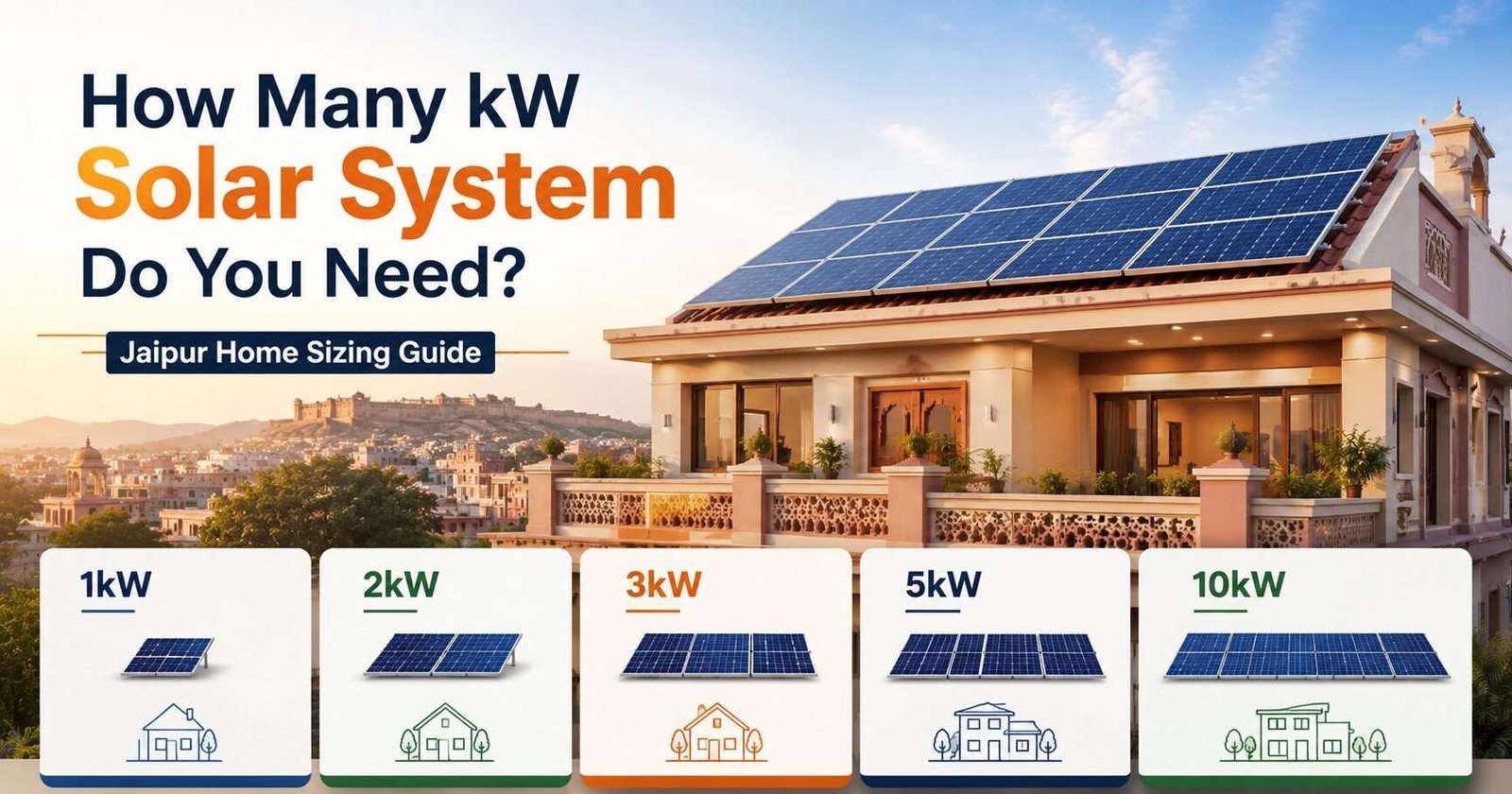
Choosing the right system size is an important part of home solar panel installation in Jaipur. Before selecting 1kW, 2kW, 3kW or 5kW, homeowners should check their electricity consumption, appliance usage and available roof space.
The answer depends mainly on your electricity consumption, not just your budget or roof size. A small family using electricity mainly for fans, lights and a refrigerator may need only a 2kW or 3kW system. A larger home with multiple ACs, geysers, water pumps and other appliances may need 5kW or more.
For homeowners in Jaipur, understanding your monthly units, appliance usage and available roof space can help you avoid two common problems: buying a system that is too small or paying for more capacity than you actually need. Choosing the right solar system size is one of the first things to consider when planning home solar installation. A reliable solar company in Jaipur can assess your electricity consumption, roof space and appliance usage before recommending the right system.
First Check Your Electricity Bill
The easiest way to estimate your solar requirement is to look at your electricity bill.
Your bill shows your electricity consumption in units, usually mentioned as kWh. One unit of electricity is equal to 1 kWh.
Instead of looking only at the rupee amount, check how many units you are using every month. Your bill amount can change because of electricity tariffs, fixed charges, taxes and other charges, while units give a better idea of your actual consumption.
For example, if your home uses around 300 units per month, you need a different solar system from a home using 700 units per month.
It is better to check the last 6 to 12 months of electricity bills because your usage may be higher during Jaipur’s hot summer months when ACs and coolers run for longer hours.
How to Estimate Solar System Size From Your Consumption
As a simple starting point, a 1kW solar system in Jaipur can typically generate around 4 to 5 units of electricity per day under good conditions. This can vary depending on sunlight, panel direction, shade, weather, panel quality and system performance.
That means a 1kW system may generate roughly 120 to 150 units in a month under suitable conditions.
A 3kW system may therefore produce around 360 to 450 units per month, while a 5kW system may produce around 600 to 750 units.
These are estimates, not guaranteed monthly production figures. Solar generation changes throughout the year.
Here is a simple reference to understand the approximate sizing:
| Monthly Electricity Consumption | Approx. Monthly Bill Range | Common Starting Size |
|---|---|---|
| 100–150 units | ₹1,500–₹2,000 | 1kW |
| 150–250 units | ₹2,000–₹3,000 | 2kW |
| 250–400 units | ₹3,000–₹4,500 | 3kW |
| 400–650 units | ₹4,500–₹6,500 | 5kW |
| 650–1,000+ units | ₹6,500–₹8,000+ | 7kW–10kW |
| Bill amounts are only indicative because electricity tariffs and other charges vary. | ||
| This table should be used for an initial estimate. Your actual requirement should be calculated from your electricity consumption and proposed solar setup. |
What Can a 1kW Solar System Handle?
A 1kW system is generally suitable for a small home with relatively low electricity consumption.
It can help cover basic loads such as:
- LED lights
- Fans
- Television
- Refrigerator
- Wi-Fi router
- Small appliances
It may be suitable for a small family or a house where electricity usage is limited.
However, if you regularly use an AC, geyser or water pump, 1kW may not be enough to offset a large portion of your electricity consumption.
Is a 2kW Solar System Enough for a Home?
A 2kW system can be a practical option for a small to medium-sized household with moderate electricity consumption.
It can work well when your main loads include fans, lights, refrigerator, television, washing machine and occasional use of heavier appliances.
If your monthly consumption is around 150 to 250 units, 2kW can be a reasonable starting point.
But do not choose 2kW simply because it costs less. If your house regularly consumes 300 or 400 units, a 2kW Solar system may leave a significant part of your electricity bill uncovered.
When Should You Consider a 3kW Solar System?
For many Jaipur homes, 3kW is a practical middle option.
It can suit a family with moderate electricity usage, especially when the home has several fans, lights, refrigerator, washing machine, water pump and other regular appliances.
A 3kW Solar system becomes more useful if you have occasional AC or geyser usage but do not run multiple heavy appliances for long periods every day.
If your consumption is around 250 to 400 units per month, 3kW is worth considering.
For homes with higher summer consumption, however, you may need to look at a larger system.
Is 5kW Solar Suitable for a Jaipur Home?
A 5kW solar system is often suitable for larger homes with higher electricity consumption.
Consider a 5kW system if your household regularly uses:
- One or more ACs
- Refrigerator
- Water pump
- Geyser
- Washing machine
- Multiple fans and lights
- Kitchen appliances
- Other high-use electrical equipment
If your monthly consumption is around 400 to 650 units, 5kW can be a suitable range to evaluate.
Homes with one or two ACs may also find 5kW more practical than trying to manage high consumption with a smaller system.
Keep in mind that AC usage can change your electricity consumption significantly during Jaipur’s summer.
Who Needs a 10kW Solar System?
A 10kW system is generally more suitable for homes with very high electricity consumption or large properties with several heavy appliances.
It may make sense for a large house where multiple ACs, geysers, pumps and other appliances are used regularly.
If your consumption is close to or above 800–1,000 units per month, a 7kW to 10kW Solar system may need to be considered, depending on your actual usage and available roof area.
A 10kW system should not be selected just because you have a large roof. If your electricity consumption is low, installing a much larger system may not be the most practical decision.
Count Your Major Appliances
Your monthly units give the best starting point, but your daily appliance usage also matters.
Make a simple list of the appliances used in your home and think about how long they normally run.
For example:
AC: An AC can become one of the biggest electricity loads in a Jaipur home. If you run one or more ACs for several hours every day in summer, your solar requirement can increase considerably.
Refrigerator: A refrigerator operates throughout the day, although its actual power consumption depends on its size, efficiency and usage.
Water Pump: A motor may not run continuously, but regular pumping can add noticeable electricity consumption.
Geyser: Geysers use significant power when heating water. Frequent use, especially in winter, should be considered while estimating your requirement.
Fans and lights: These are usually easier to estimate because their daily operating hours are more predictable.
You do not need to calculate every appliance perfectly. Your electricity bills already provide a useful picture of total consumption. Appliance usage simply helps explain why your consumption is high or low.
Family Size Also Matters
The number of people living in your house can affect electricity consumption, but family size alone should not decide your solar system size.
A four-member family that uses two ACs every day may consume more electricity than a six-member family that uses only fans and basic appliances.
Instead of asking, How many people live in the house? ask:
- How many ACs are used?
- How many hours do they run?
- How often are geysers used?
- How frequently does the water pump run?
- How many refrigerators are there?
- Are washing machines, dishwashers or other appliances used regularly?
These details give a much better picture of your actual requirement.
How Much Roof Space Do You Need?
Your roof must have enough usable space for the solar panels.
The exact area depends on the panel wattage and panel dimensions, but as a basic planning estimate, around 70–100 square feet of usable shadow-free roof area may be required per kW for many residential installations.
For example, a 3kW system may need roughly 210–300 square feet, while a 5kW system may need around 350–500 square feet.
This is only a planning estimate. The actual requirement depends on the type and wattage of panels selected and how they are arranged.
The roof should also be checked for:
- Shade from nearby buildings or trees
- Water tanks
- Staircases
- Solar water heaters
- Existing structures
- Panel installation direction
A large roof does not automatically mean you should install a large solar system.
Jaipur Sunlight and Solar Generation
Jaipur receives strong sunlight for much of the year, which is favourable for rooftop solar.
A solar system does not produce the same amount of electricity every day. Its output depends on available sunlight, season, temperature, panel orientation, shading, dust and other conditions.
For basic planning, homeowners can think in terms of roughly 5–6 peak-sun-hours of solar resource on a good average day, while actual system generation will vary.
This is why a 1kW system does not simply generate 1 unit every hour from sunrise to sunset. Solar production rises after sunrise, reaches higher levels around the middle of the day and falls later in the afternoon.
Jaipur’s hot and dusty conditions also make regular panel cleaning and proper installation important for maintaining performance.
Common Mistakes When Choosing Solar System Size
Choosing Based Only on Budget
One of the biggest mistakes is saying, My budget is ₹2 lakh, so I will buy whatever system fits within it.
Your budget matters, but your electricity consumption should come first.
A cheaper system that is too small may not reduce your electricity bill as much as you expect.
Choosing the Largest System Available
The opposite mistake is installing 10kW simply because you have enough roof space.
A larger system costs more and may not provide additional value if your electricity consumption is much lower.
Looking Only at the Current Bill
Do not look at just one month’s bill.
Your electricity usage may be very different in May compared with January. Check several months to understand your normal and peak consumption.
Ignoring AC Usage
In Jaipur, AC usage can increase electricity consumption sharply during summer.
If you are planning to install another AC, buy a new geyser or add other major appliances, mention this during your solar consultation.
Ignoring Roof Shade
Even if you choose the correct kW size, shading can reduce solar generation.
A site inspection should check the roof throughout the day before finalising the panel layout.
What Size Solar System Is Right for You?
There is no single solar size that is best for every Jaipur home.
As a quick starting point:
- 1kW: Low electricity consumption and basic household loads
- 2kW: Small home with moderate consumption
- 3kW: Medium household with moderate-to-higher usage
- 5kW: Larger home with ACs and several electrical appliances
- 7kW–10kW: High-consumption homes with multiple heavy appliances
The right choice should be based on your actual electricity units, expected future consumption, available roof space and the type of solar system being installed.
Get Your Home Solar Requirement Checked
If you are still confused between 3kW, 5kW or 10kW, do not decide only from an advertisement or a price quote.
Agrawal Solar Energy LLP can assess your electricity consumption, roof space, shading conditions and household requirements before suggesting a suitable solar system size.
A proper site assessment can help you avoid spending money on an oversized system or installing one that is too small for your home.
If you are planning to install Home solar panel installation in Jaipur install contact Agrawal Solar Energy LLP for a free site assessment or consultation and find out which kW solar system is suitable for your actual electricity needs.